Tech
Bits, bytes, and blinkin’ lights.
Bits, bytes, and blinkin’ lights.
The objective was simple: Build a home server with ECC memory, lots of space for NVMe drives and 3.5” hard drives, fast Ethernet networking, and as low a power draw as possible. As it happened, this task ended up consuming the last year or so of my computing hobby, so I figured I’d memorialize my struggle with a short epitaph....
It’s 2026 and I’m still hopelessly addicted to Gmail, the red letter “M” forever pinned to the top-left corner of my browser window. In my humble opinion, Google’s psychedelic concoction of a web-first interface, powerful filtering tools, reliable push delivery, and seamless integration with Android still cannot be beat. (Among the competition, Outlook is really the only webmail service that...
Netbooks? Remember those? Sub-10-inch, horribly underpowered, miniature laptops? Asus Eee PC? One Laptop Per Child? Netbooks were all the rage in the late 2000’s. And then, like Zune, the Windows Phone, and the Avatar, they disappeared.
Let’s be clear: The netbooks of yesteryear were pieces of utter garbage. Their under-specced innards could barely keep pace with the copies of Windows...
TL;DR Use go-getmail to sync your indie, IMAP inbox to another IMAP inbox supported by Gmailify like Outlook.com in combination with Gmailify to achieve a (nearly) perfect Gmail setup.
For as long as I can remember being a sentient Internet user, I have called myself a Gmail addict. I remember chatting with online buddies in the embedded Google Talk widget....
GitHub recently made Codespaces available to every GitHub user, and they’ve been getting rave reviews. Like a digital petting zoo in the cloud, a Codespace is a virtual machine built just for programming that you can access through any ordinary web browser. Code on your ultrabook, your iPad, even your phone; it’s easy to see the appeal. The promise of...
It goes without saying that 2020 has been the year of the inconceivable. And to top it all off, after daily driving Linux on my laptop for nearly a decade, I just switched back to Windows!
Let me explain—it’s not as if I’ve given up on the Penguin OS entirely. My servers and routers continue to run Linux, delivering funny...
In my family, the person with the fastest Internet connection is… Grandma, a Vietnam War refugee who has never used a computer in her life. This is by virtue of her residence on a main road in the great state of Delaware, which gets fiber TV and Internet service through Verizon FiOS. She subscribes to the cheapest Internet plan so...
(Web technology changes fast! Mind the date this post was written, which was November 2019.)
I get the feeling nobody uses WebRTC in the real world, since all of the tutorials use the same toy examples that don’t involve any actual network connectivity. That’s a shame, because WebRTC makes peer-to-peer communication a cakewalk. Somewhere in our imaginations, there’s a...
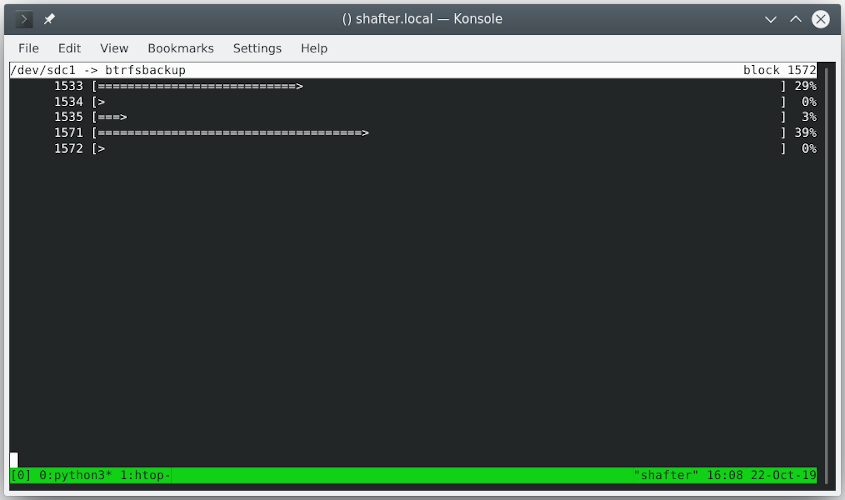
Sia Slice in action. (On a remote system, with tmux.)
I dabble in cryptocurrencies, occasionally. I hesitate to get too partisan on a subject the Internet takes very seriously, but it seems to me that the fairest judge of a coin’s value is the utility it provides to its holders. So Bitcoin is useful because everyone recognizes and accepts Bitcoin,...
This post was rewritten on July 26, 2019 to incorporate a cleaner solution. The original version can be viewed here.
LXD is my favorite containerization stack. For my use case, which is running various services on the same machine with isolated root filesystems, it’s more flexible and easier to use than Docker, particularly in terms of networking capabilities.
Using...